
Program Structure
The M.Sc. in Economic Analysis and Data Science (MEADS) awards a Master of Science in Economic Analysis and Data Science. The programme is designed to provide students with a strong foundation in economic theory, applied economics, econometrics, data analytics, and modern quantitative methods.
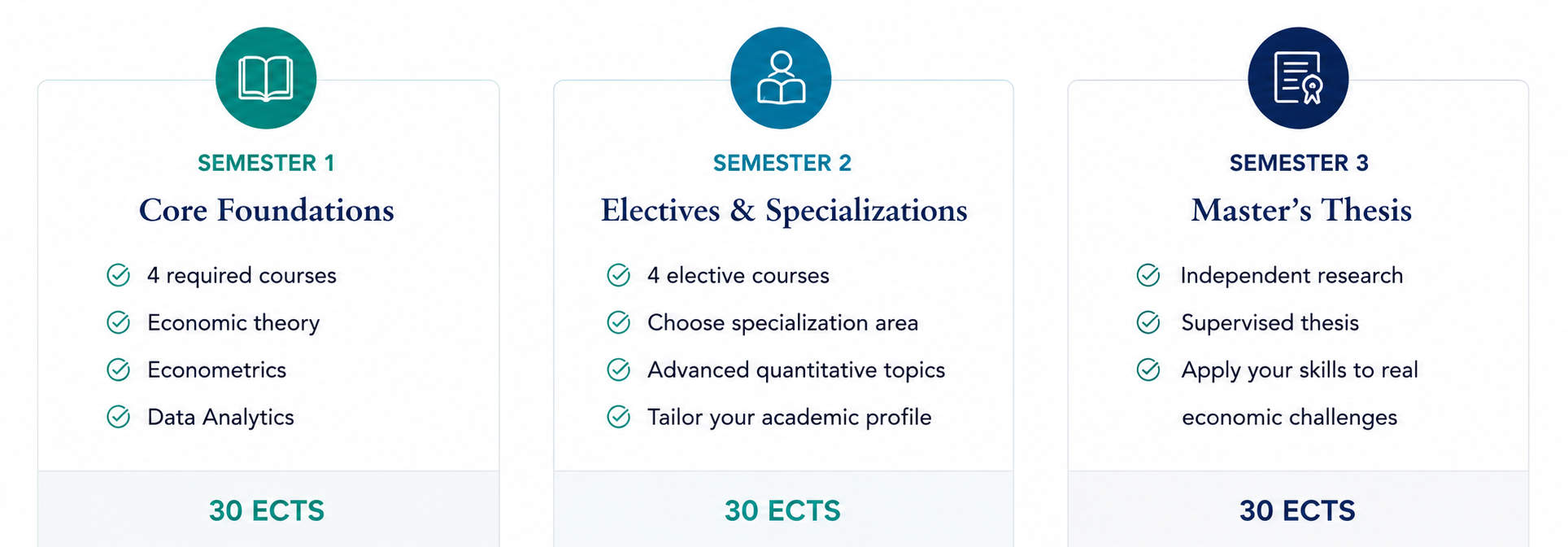
The total workload required for the completion of the programme is 90 ECTS credits. The programme is structured over three semesters:
Semester 1
Introduces students to the core analytical and quantitative foundations of the programme through required coursework.
Semester 2
Allows students to shape their academic profile by selecting four elective courses, with the possibility of completing at least one area of specialization.
Semester 3
Is devoted to the preparation of the Master’s Thesis, through which students apply economic analysis and data-science methods to a research question of academic, policy, or professional relevance.
Curriculum Overview:
| Semester | Component | Courses / Requirements | ECTS |
|---|---|---|---|
| 1st Semester | Required coursework | 4 required courses | 30 |
| 2nd Semester | Elective coursework | 4 elective courses | 31 |
| 3rd Semester | Master’s Thesis | Independent research thesis | 32 |
Total Programme Workload 90 ECTS
1st Semester: Required Courses
During the first semester, all students complete four required courses. These courses provide the common analytical foundation of the programme and ensure that students acquire the core tools needed for advanced study in economics and data science.
| Code | Course | Type | Teaching Hours | ECTS |
|---|---|---|---|---|
| MEADS 500 | Microeconomics | Required | 39 | 7.5 |
| MEADS 501 | Macroeconomics | Required | 39 | 7.5 |
| MEADS 502 | Data Analytics for Applied Economics | Required | 39 | 7.5 |
| MEADS 503 | Econometrics I | Required | 39 | 7.5 |
Total 1st Semester ECTS 30
2nd Semester: Elective Courses and Specialization
During the second semester, students choose four elective courses. Electives allow students to deepen their knowledge in selected fields and develop a profile that reflects their academic interests and career objectives.
| Course | Type | Teaching Hours | ECTS |
|---|---|---|---|
| Elective Course 1 | Elective | 30 | 30 |
| Elective Course 2 | Elective | 30 | 30 |
| Elective Course 3 | Elective | 30 | 30 |
| Elective Course 4 | Elective | 30 | 30 |
Total 2st Semester ECTS 30
Students may choose to complete their studies with at least one area of specialization, provided that they successfully complete the courses corresponding to the selected field, as defined in the curriculum. Where applicable, the Master’s Thesis may also be prepared within the chosen area of specialization.
3rd Semester: Master’s Thesis
The third semester is dedicated to the preparation of the Master’s Thesis, which carries 30 ECTS credits. The thesis gives students the opportunity to conduct independent research and apply the analytical, empirical, and computational tools developed during the programme.
The thesis may focus on topics related to economic analysis, data science, applied econometrics, policy evaluation, industrial organization, public and environmental economics, financial and monetary economics, or other relevant fields approved by the programme.
| Component | Type | ECTS |
|---|---|---|
| Master’s Thesis | Thesis | 30 |